Mechanical Accountability in Training: Push / Pull / Legs
A Joint-Action Audit Using the Completeness Principle
New here? This article builds on the framework introduced in The Completeness Principle. Reading that first will make everything here clearer.
Learn more about the Framework and the audit tool on our website:
https://thecompletenessprinciple.com
The Program
The Push / Pull / Legs split is one of the most widely used structures in resistance training. It is simple, effective, and widely adopted across both recreational and advanced populations.
This audit evaluates that structure through a different lens: mechanical coverage of joint actions.
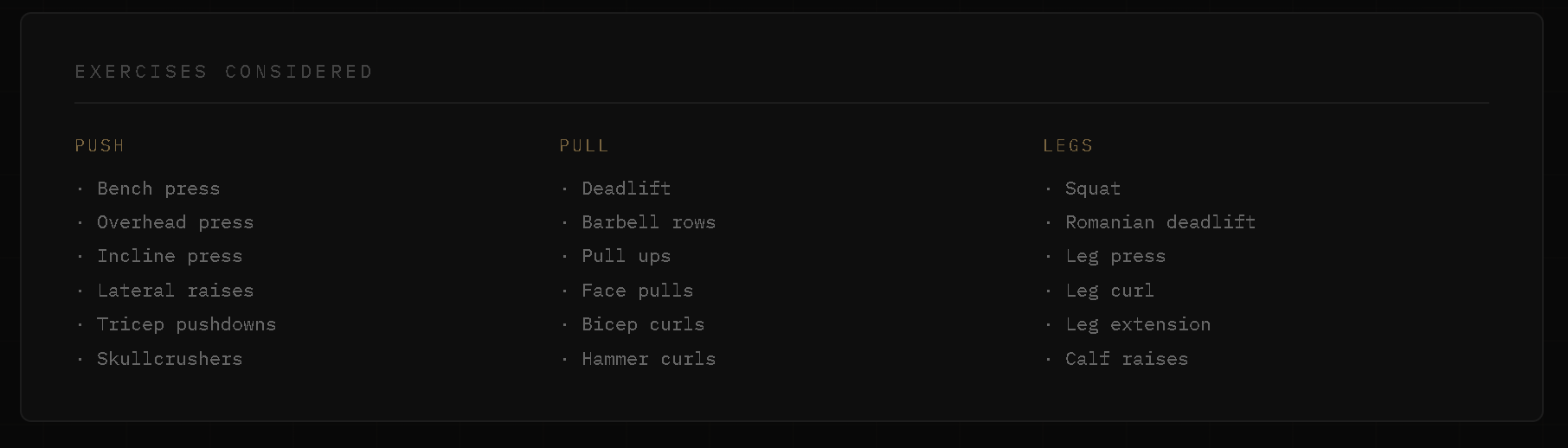
Exercise Selection
To ensure relevance, the exercise selection was derived from widely used hypertrophy templates, including those popularized by coaches such as Jeff Nippard.
The goal is not to evaluate a specific program, but to evaluate the structure itself.
Program Used for Audit.
The Audit
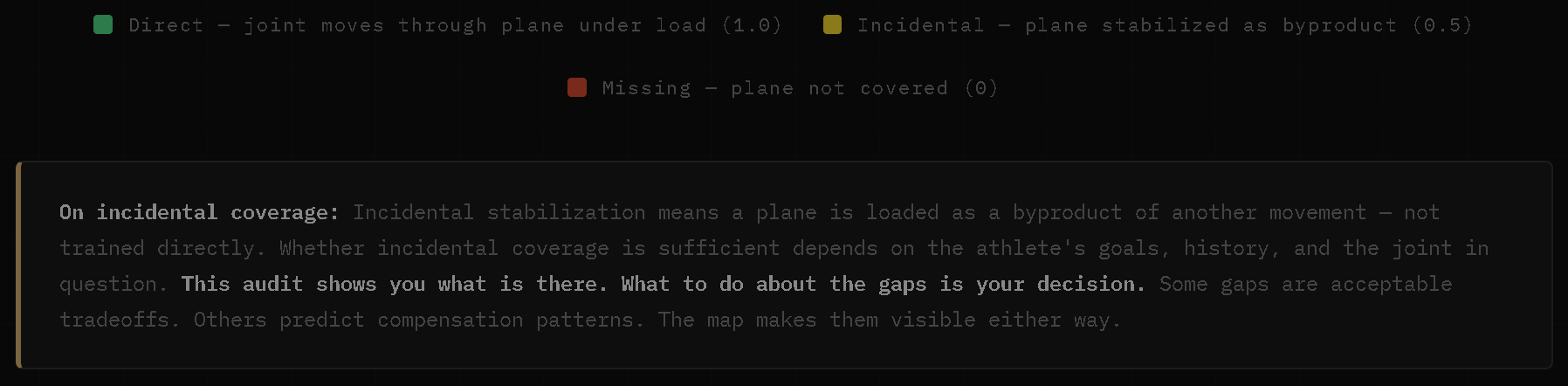
Each exercise was mapped to joint actions using a consistent classification:
Direct (1.0) — joint moves through range under load
Incidental (0.5) — joint contributes through stabilization
Absent (0.0) — no meaningful stimulus
All joint actions can be found in the Periodic Table of Joint Mechanics.
Results
Direct Coverage: 16 / 52 (31%)
Weighted Coverage: ~20 / 52 (~39%)
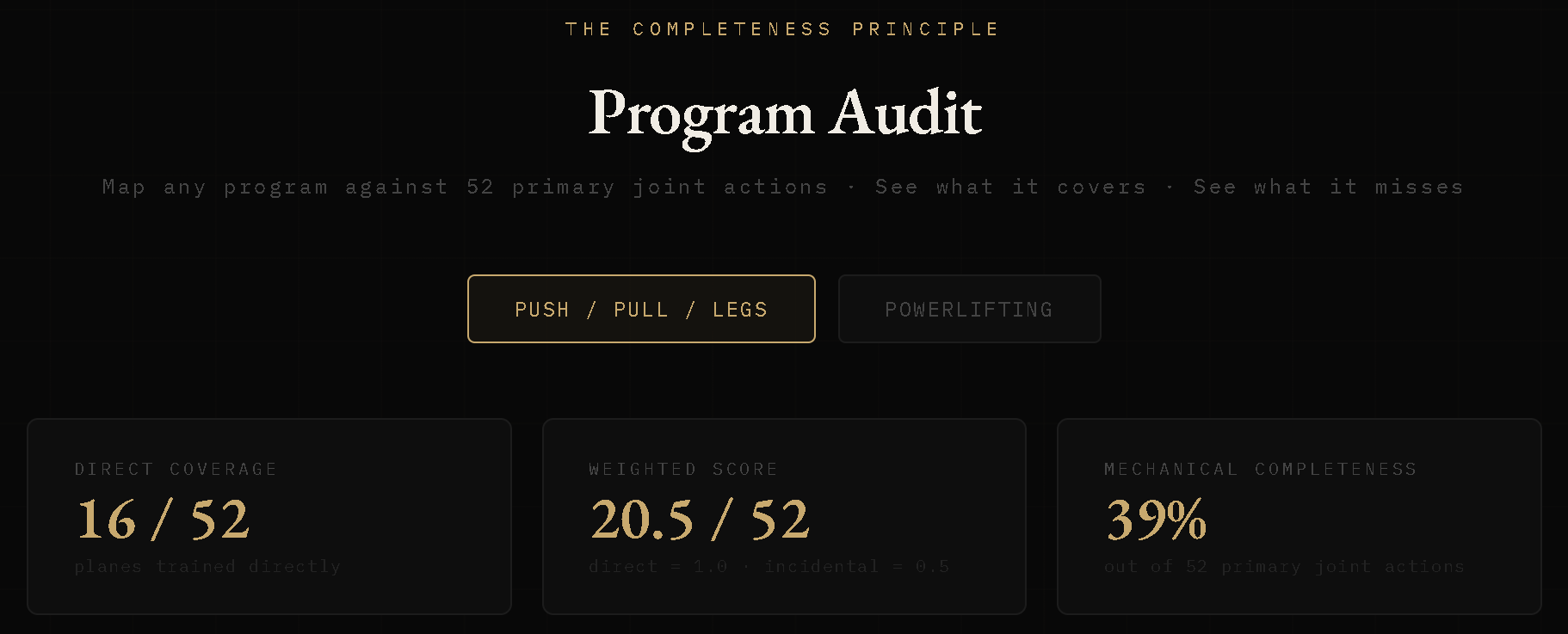
Weighted score includes incidentally covered joint actions
Observed Gaps
Despite covering all major muscle groups, large portions of the mechanical map remain untrained.
Key absent categories include:
Shoulder internal rotation
Hip rotational and frontal plane actions
Ankle dorsiflexion, inversion, and eversion
Forearm rotational and deviation patterns
Spinal rotation and lateral flexion
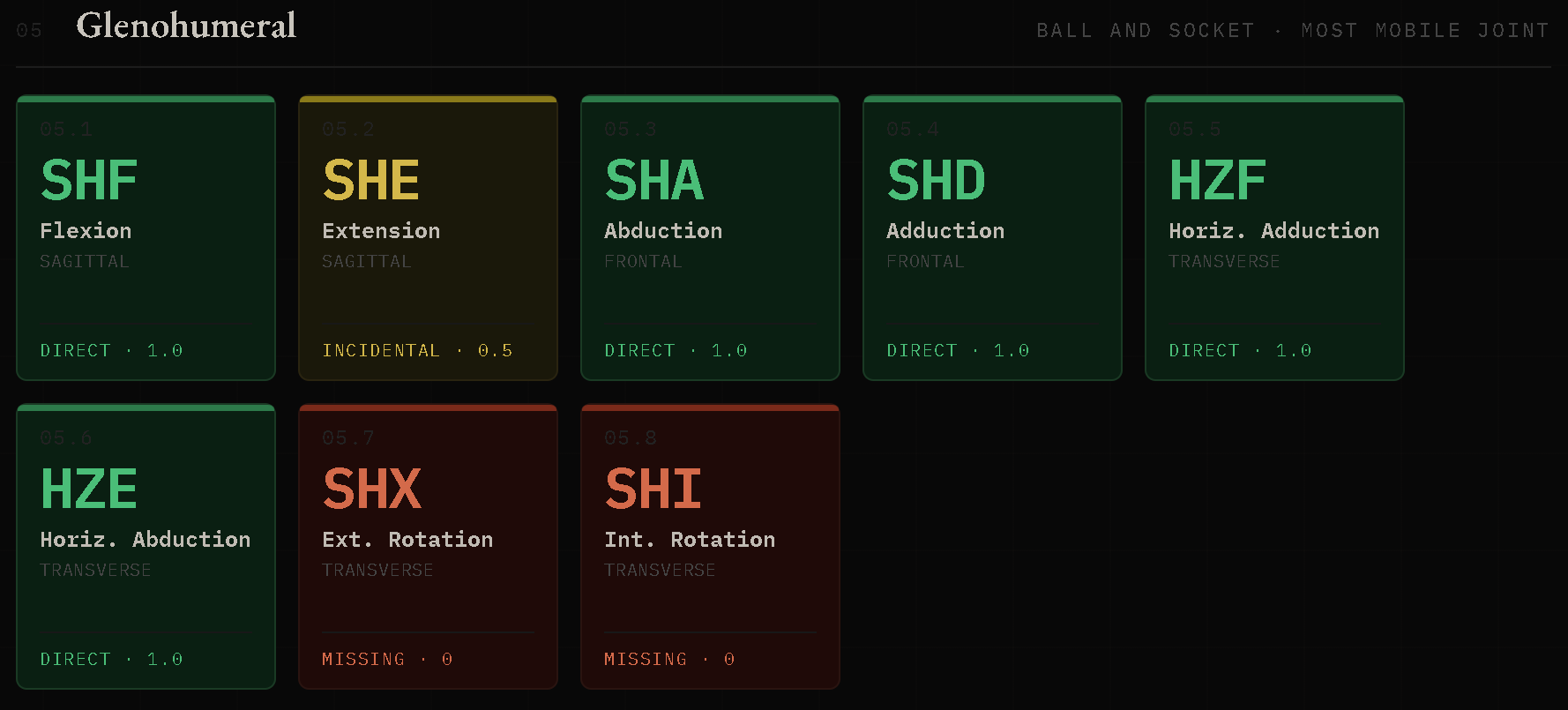
Example: Shoulder
The program includes pressing, pulling, and lateral raise variations, producing strong coverage in flexion, extension, and abduction.
However, rotational capacity is not directly trained.
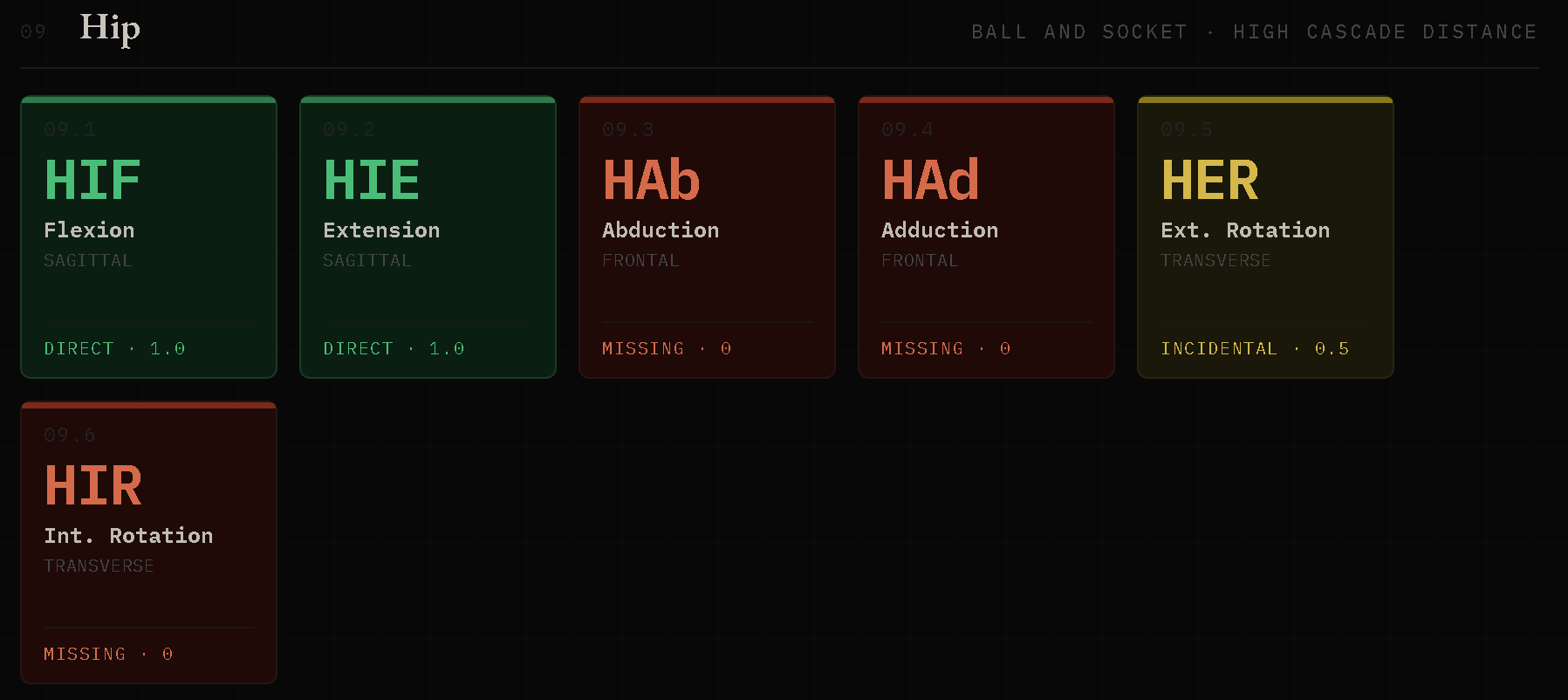
Example: Hip
The program effectively trains hip extension through squats and hinges.
However, abduction and rotational actions are absent.
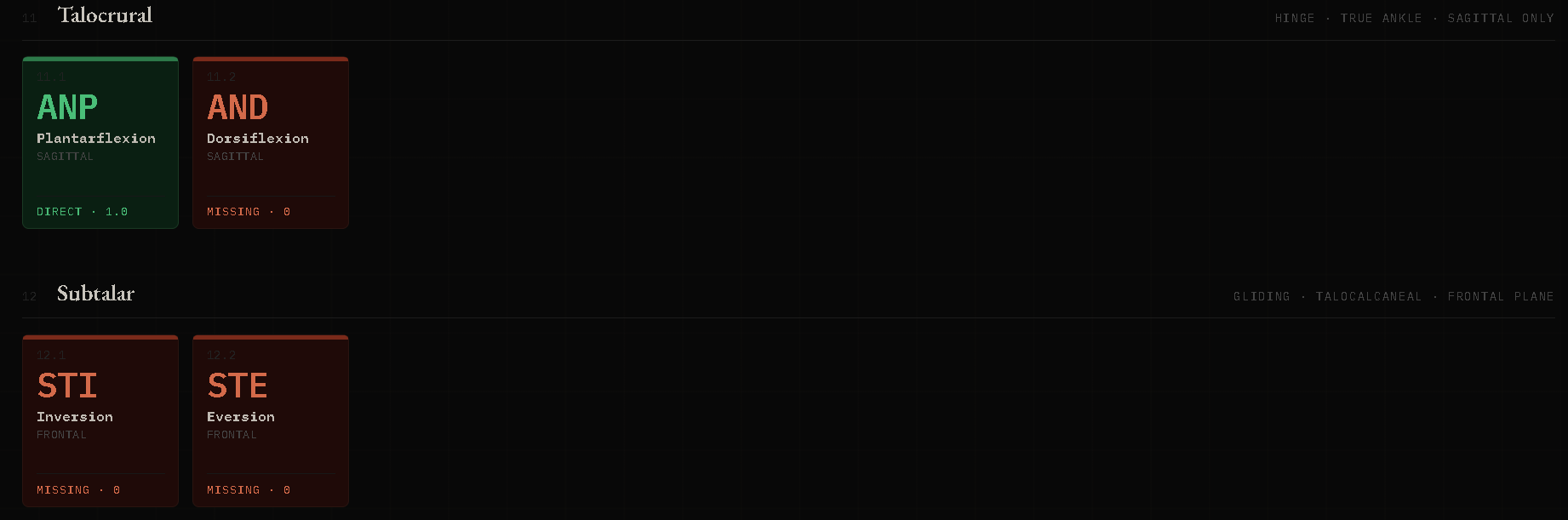
Example: Ankle
Only plantarflexion is trained.
Three primary joint actions remain unaddressed.
Interpretation
This is not a failure of effort, intensity, or exercise selection.
It is a limitation of the organizing framework.
The Push / Pull / Legs structure distributes work effectively across muscle groups, but does not account for the full set of joint actions.
Conclusion
The audit does not prescribe changes.
It makes the structure visible.
This system does not tell you what to do. It shows what is currently there.