The Completeness Principle
A Periodic Table of Joint Mechanics
Framework Introduction
The Muscle Group Problem
The human body contains over 600 muscles.
No serious athlete memorizes all of them. No training program directly addresses all of them. And no coach sitting down to write a program thinks in terms of 600 individual structures that each need their own stimulus.
So programs simplify. They organize training around muscle groups — chest, back, legs, shoulders, arms. The logic is reasonable. Hit the big groups, the smaller muscles follow along.
Except they don’t. Not reliably. Not completely.
The muscle group framework is an approximation. It works well enough for the major movers. It fails systematically for the structures that don’t fit cleanly into a group name. The muscles nobody thinks about until they fail.
There is a better framework. One that doesn’t require memorizing 600 muscles. One that makes completeness auditable rather than assumed.
The Abstraction
Muscles don’t move independently. They act on joints. And joints don’t move randomly — they move in specific, finite directions determined by their anatomy.
That’s the key insight.
Instead of asking which muscles am I training, ask which joint directions am I training. The muscles that drive each direction are trained as a consequence. Not as an assumption. As a mechanical certainty.
Across the twelve major joint systems there are roughly fifty-two primary joint actions.
Fifty-two directions. Not 600 muscles.
That number is manageable. It can be mapped. It can be audited. And when every direction is covered, every muscle that drives those directions is trained — including the ones nobody remembers to program directly.
This is the foundational claim of The Completeness Principle.
Mechanical completeness produces muscular completeness automatically.
What a Joint Action Looks Like
Take the forearm.
Most people think of forearm training as wrist curls. Maybe reverse curls. The forearm as an afterthought at the end of a back session.
The forearm complex has six primary actions across three planes of motion.
Flexion and extension — the wrist bending toward the palm and toward the back of the hand. The sagittal plane. The actions most programs address, however minimally.
Pronation and supination — the forearm rotating so the palm faces down or up. The transverse plane. The actions almost no program trains directly.
Ulnar and radial deviation — the wrist tilting toward the pinky side or the thumb side. The frontal plane. The actions essentially no program trains at all.
Six actions. Three planes. One joint system.
Most programs cover two of those six. The other four exist in the map whether they appear in the program or not.
Here is what those six actions look like on the mechanical map.

Each cell represents one joint action. The color tells you its coverage status in the program being audited — directly trained, incidentally stabilized, rotating across the cycle, or absent entirely.
The audit doesn’t require knowing the name of every muscle in the forearm. It requires knowing whether the program moves through each direction. That’s a question any athlete can answer by looking at their exercise list.
Check out the full Periodic Table of Joint Mechanics
The Full Map
The forearm is one of ~12 joint systems.
Scale the same logic across every joint in the body — the hip, the spine, the shoulder, the knee, the ankle, the elbow, the wrist, the cervical spine — and the complete mechanical map emerges.
Roughly fifty joint actions. Every direction the body can move. Every mechanical demand that must be met for the system to function completely.
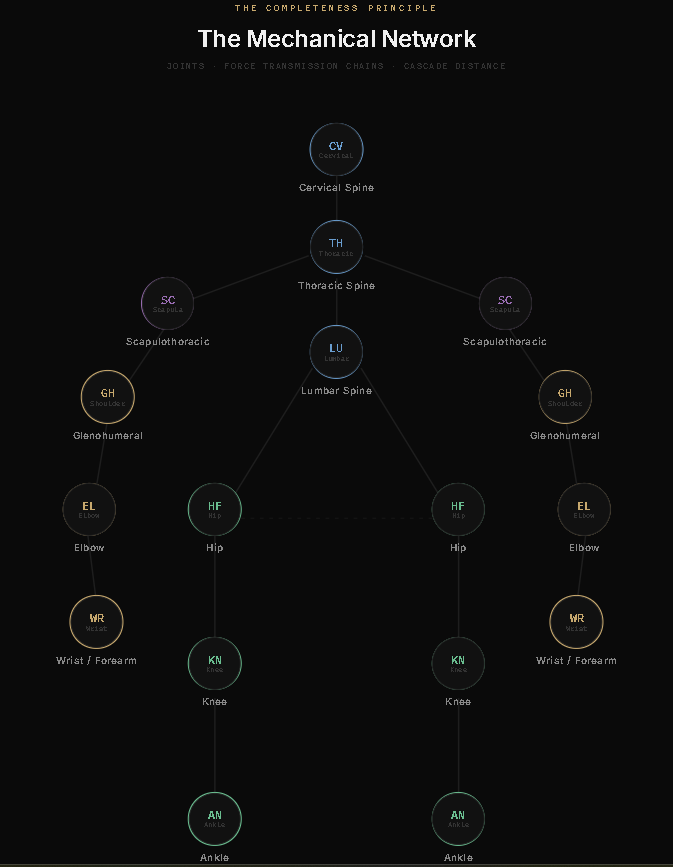
A deficit at any node doesn’t just affect that joint. It travels. The hip’s missing planes become the lumbar spine’s compensation. The lumbar spine’s compensation becomes the knee’s problem.
The map makes those connections visible before the compensation appears.
The Audit
This is what The Completeness Principle does in practice.
Take any training program. Map each exercise against the joint action grid. Mark each cell as directly trained, incidentally stabilized, rotating across the cycle, or absent. The gaps become visible immediately.
Not after an injury. Not after years of accumulated compensation. At the moment of program design.
The framework doesn’t tell you what program to run. It tells you what your program is actually doing — and what it isn’t.
From those two things everything else follows. Where to add direct work. Where incidental coverage is sufficient. Which gaps predict problems and which are acceptable tradeoffs given the athlete’s goals and history.
No muscle memorization. No guesswork. A complete mechanical map and an honest audit.
That is The Completeness Principle.
The question is no longer whether a program trains hard enough.
The question is whether it trains completely.
Upcoming articles go deeper into the framework’s structure — how coverage is classified, how planes can be distributed across the training cycle, and why the audit matter for injury prediction.
Check out the full Periodic Table of Joint Mechanics
Learn more about the Framework and the audit tool on our website: